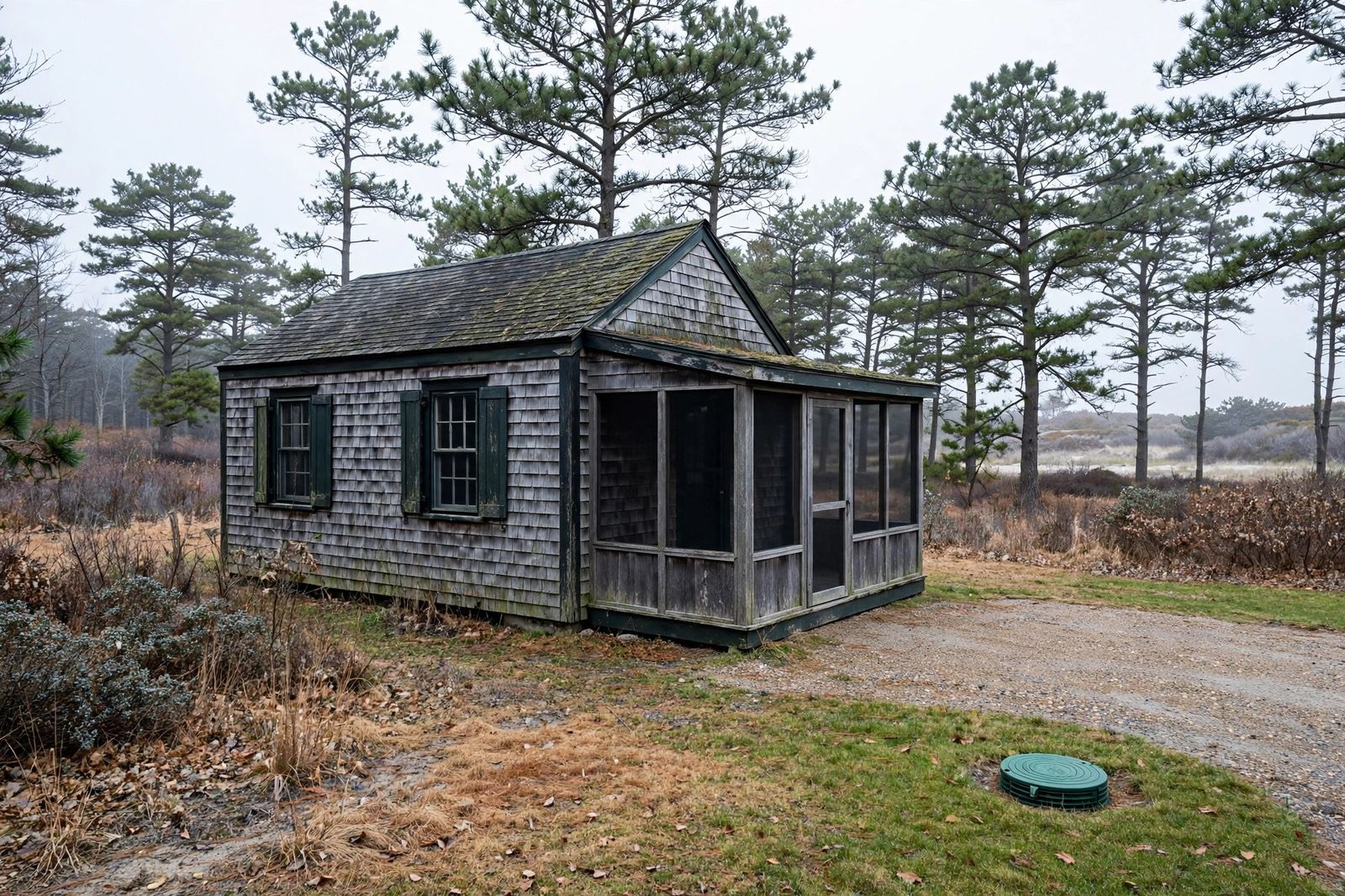
Barnstable Septic is a Hyannis-based company, and in Dennis the septic question tends to arrive attached to a purchase and sale agreement. About half of the town's housing units are seasonal or second homes, against about 36 percent across the region, so Title 5 inspections are part of how property changes hands here, not an occasional chore. A house that sits closed for months and then goes to market often has a surprise in the ground: a tank nobody has opened in years, a failed component that calls for septic repairs, or a pit where the family assumed there was a tank. Reading the tank properly usually starts with septic pumping, which is why the two are so often booked together.
What the inspection finds decides everything after it. A pass closes the question for its window. A conditional pass names a part to fix. A failure means an upgrade, and on Dennis lots that can be cesspool replacement or a full septic system replacement. Where the Board of Health asks for it on a given site, it can mean one of the nitrogen-reducing I/A systems. For the seasonal owner who is not selling at all, steady septic maintenance is what keeps the report from ever reading that way.
Have a Dennis closing on the calendar, or a house nobody has ever had looked at? Call (774) 619-8331, Monday to Friday, 9:00 AM to 5:30 PM, or send the short form at the foot of this page with your name and number. Tell us the street and the closing date if there is one, and we will start from there.
Dennis, and why the inspection is always in play
Dennis has about 15,000 year-round residents and a summer population that passes 60,000. About three quarters of the homes are single-family houses, many of them owned by families who have held them for a long time and use them in season. In a market like that, transfers are constant, whether through sales, estates, or a younger generation buying out the rest. Every transfer starts the same clock under Title 5. The system must have been inspected within the two years before the property changes hands.
The inspection is priced at $475 to $850. Booked together with pumping, the two come to $600 to $1,200. Pumping first is not an upsell. An inspector cannot judge sludge depth, baffles or the condition of the outlet tee in a tank that is full to the brim.
Only inspectors approved by MassDEP may do the work. The report goes on the state form to the Board of Health within 30 days of the inspection, and the seller gives the buyer a copy.
The second-home owner's inspection calendar
A system in a seasonal house lives an odd life. It sits idle through the cold months and then takes a full household, plus guests, from June to September. The calendar below follows what the regulation asks of an owner across that cycle.
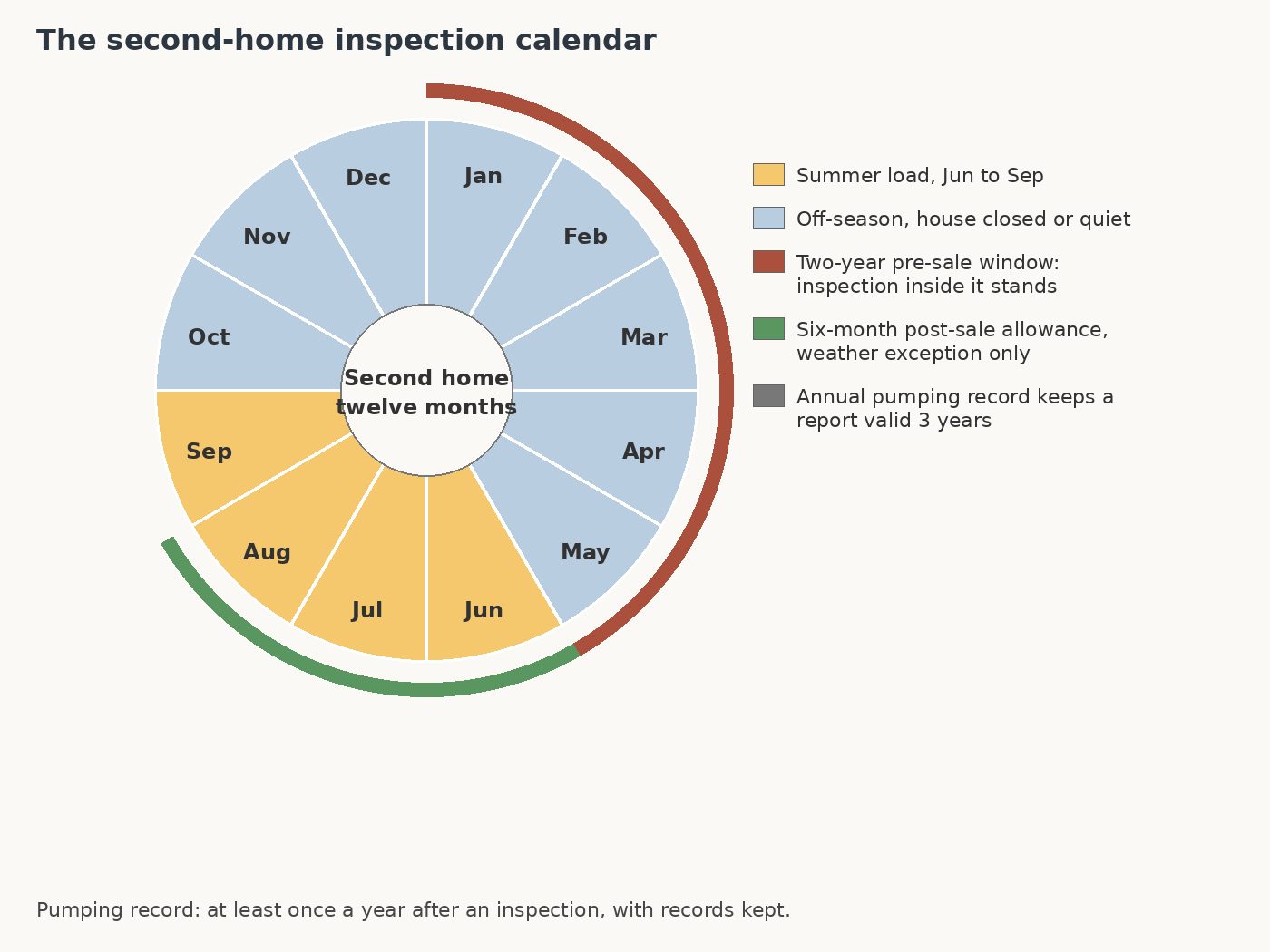
If you may sell within a couple of years. An inspection inside the two years before closing is what the rule requires, so an owner who has it done early, and then relists after a sale falls through, is still covered while the window holds. Weather is the one exception. If the weather prevents the inspection at sale, it may be done within six months after, with written notice to the buyer.
If you want the report to last. An inspection stays valid for three years when the system is pumped at least once a year after it, with records. For a second-home owner who has a sale in mind but no date, that is the practical reason to keep pumping receipts in the house file.
Every year you own it. MassDEP's guidance is to pump at least once every three years for a home without a garbage disposal and every year for one with a disposal. A 1,500-gallon tank is pumped for $375 to $575. A house that is full for ten weeks and empty for the rest of the year still has the load the bedroom count implies when it is full.
When you change the house. A project that needs a building or occupancy permit, such as an added bedroom or a change of use, triggers an inspection of its own. Title 5 sizes a home at 110 gallons per day per bedroom, with a 330 gallon minimum, and flow may not be increased beyond the approved design until the system is upgraded. Turning a summer house into a year-round one with an extra bedroom is exactly the situation that rule was written for.
Featured job: a Dennis Port family house that sat on a cesspool
The situation
A family on Lower County Road in Dennis Port had owned the house for decades, using it through the summer and into the fall. The next generation decided to sell. The listing agent told them a Title 5 inspection would be needed before the closing, and the family was untroubled. As far as they knew the house had a tank and a leach field, because the toilets had always flushed and nothing had ever backed up. They booked the inspection with pumping, a combined $600 to $1,200 job.
What was found
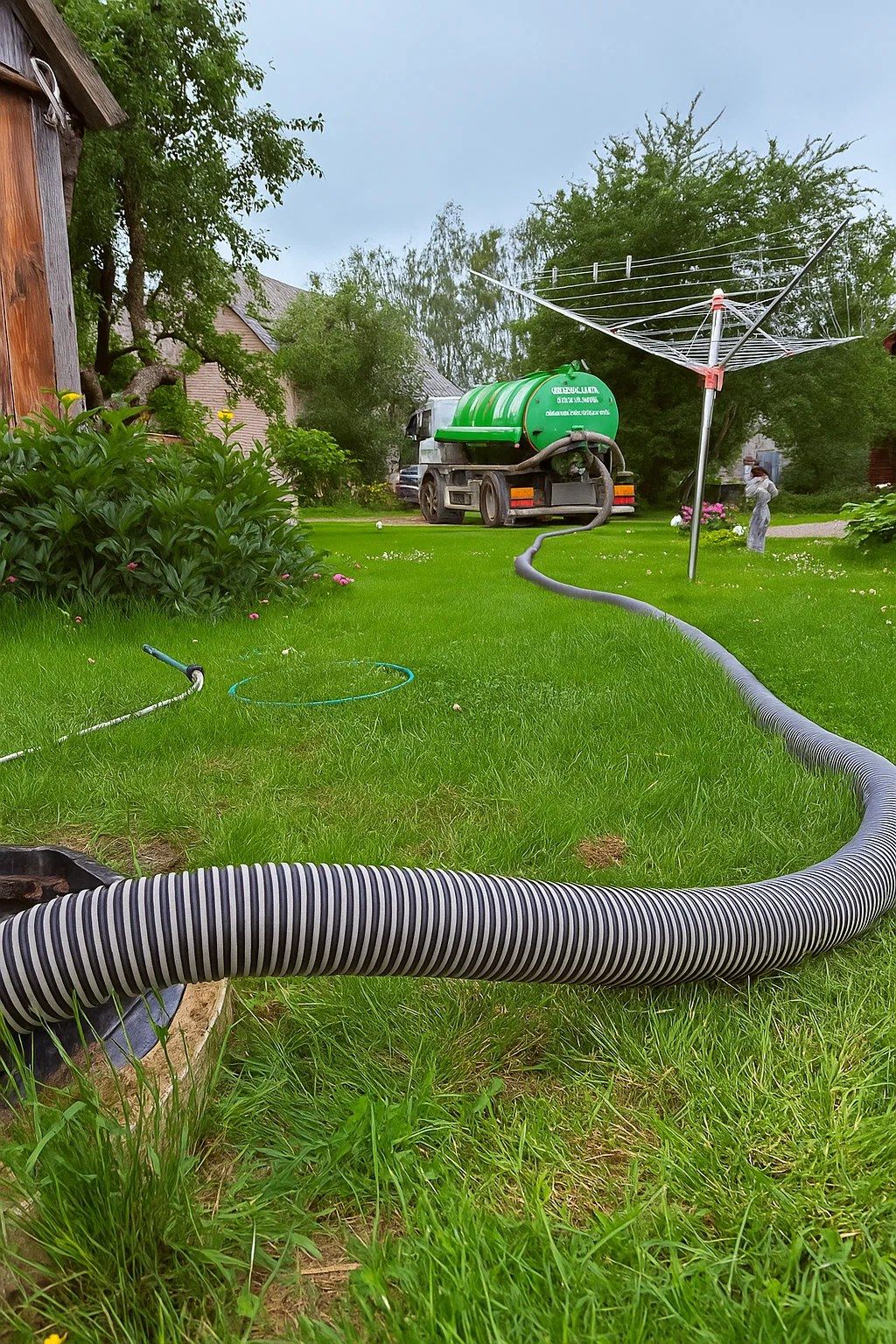
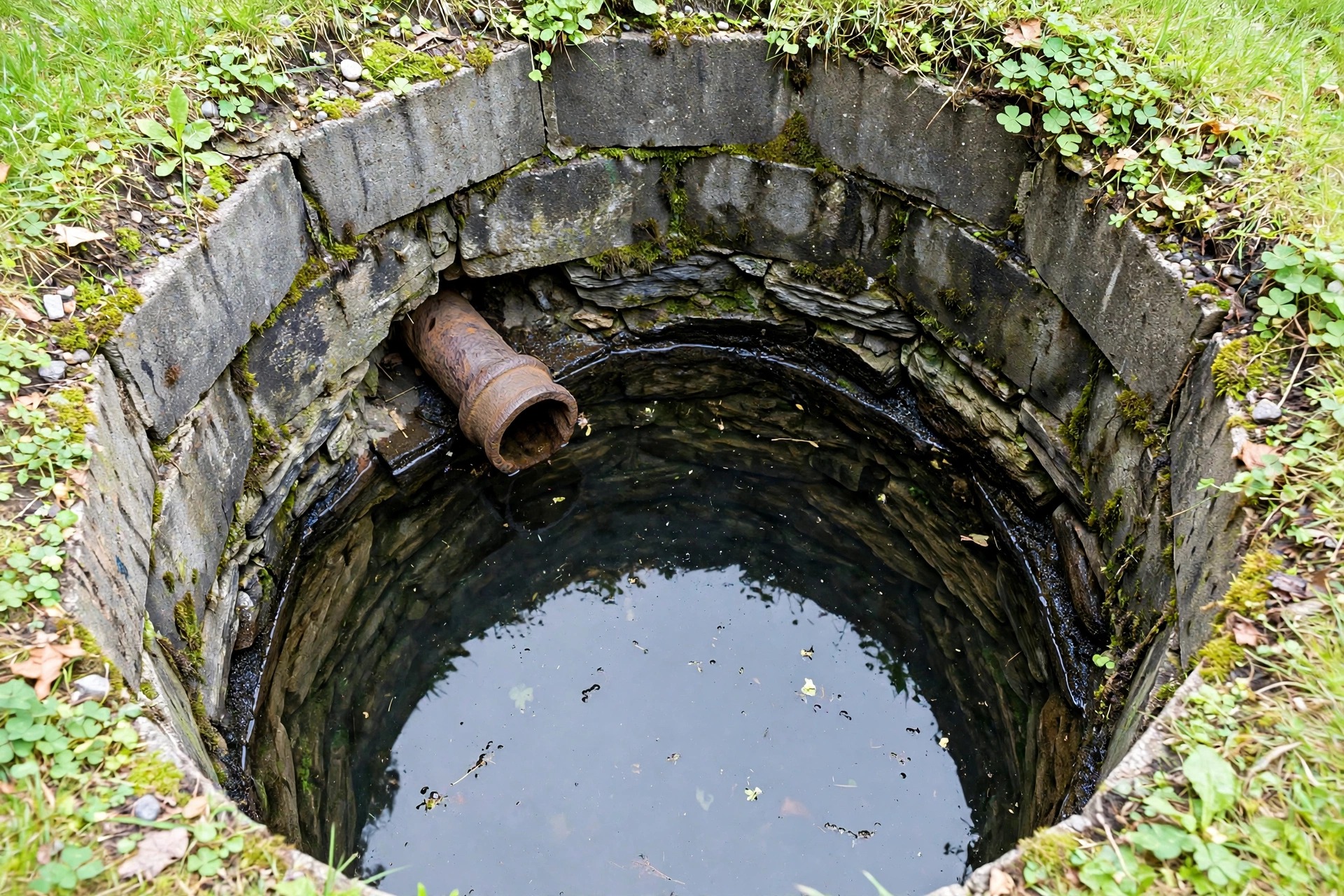
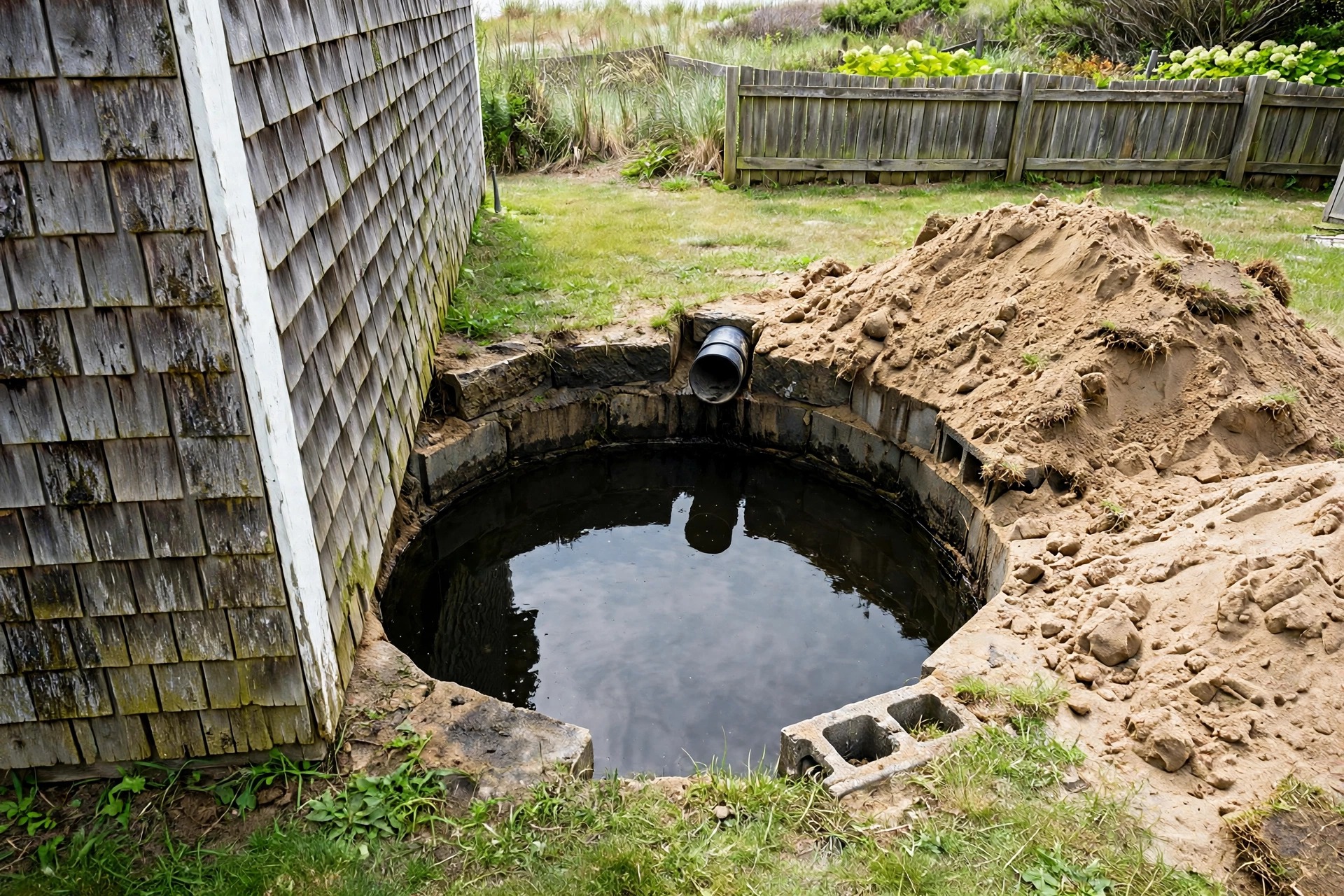
The inspector probed for a tank and did not find one. What lay under the lawn was a cesspool, an unbaffled lined pit with no tank ahead of it, probably built when the house was first winterized and never mentioned afterward. Once it was opened, the measures that matter were plain. The liquid stood within 6 inches of the inlet. After pumping, the pit held little reserve above the liquid, well under the half a day's design flow that the regulation expects. For a three-bedroom house that half-day figure is about 165 gallons. By the regulation's criteria this was a failed system.
The report went on the state form to the Board of Health within 30 days. The sellers gave their buyer a copy.
The decision
The sellers had three questions in front of them, and the regulation answers part of each.
*Upgrade before the closing.* The cleanest route is to leave the buyer a compliant system. The county's AquiFund betterment loan is built for this. Septic work carries the 4 percent and 5 percent rates, 5 percent where the property is listed or expected to be listed within 12 months. The loan is repaid on the tax bill over up to 20 years and paid directly to the contractor, so the sellers do not have to carry the full cost up front. How a betterment is handled at the closing is a conversation for the sellers' attorney. The state septic tax credit did not help here. It applies to a principal residence, and this was a second home.
*Price the work into the sale.* Sellers can disclose the failure and adjust the price, leaving the buyer to do the upgrade. That keeps the sellers out of a construction project. It also puts a number on the table that both sides have to believe. A conventional replacement is $18,000 to $32,000, or $25,000 to $40,000 on a tight lot. If the Board of Health were to require a nitrogen-reducing system instead, that is $32,000 to $55,000, and $45,000 to $75,000 or more on a tight lot with a high water table.
*The two-year duty, and who carries it.* A failure means upgrade within two years, unless the Board of Health or MassDEP sets another schedule, and sooner if there is an imminent hazard. The regulation puts the duty on the owner, and it does not go away if the sale falls through. Pricing the work into the sale moves the cost to the buyer. It does not remove the obligation, and if the buyer walks, the family still owns a failed cesspool with the clock running.
The family chose to replace before closing. The house was on a lot that could take a conventional design, so the work fell in the conventional range of $18,000 to $32,000, not the tight-lot band.

The work
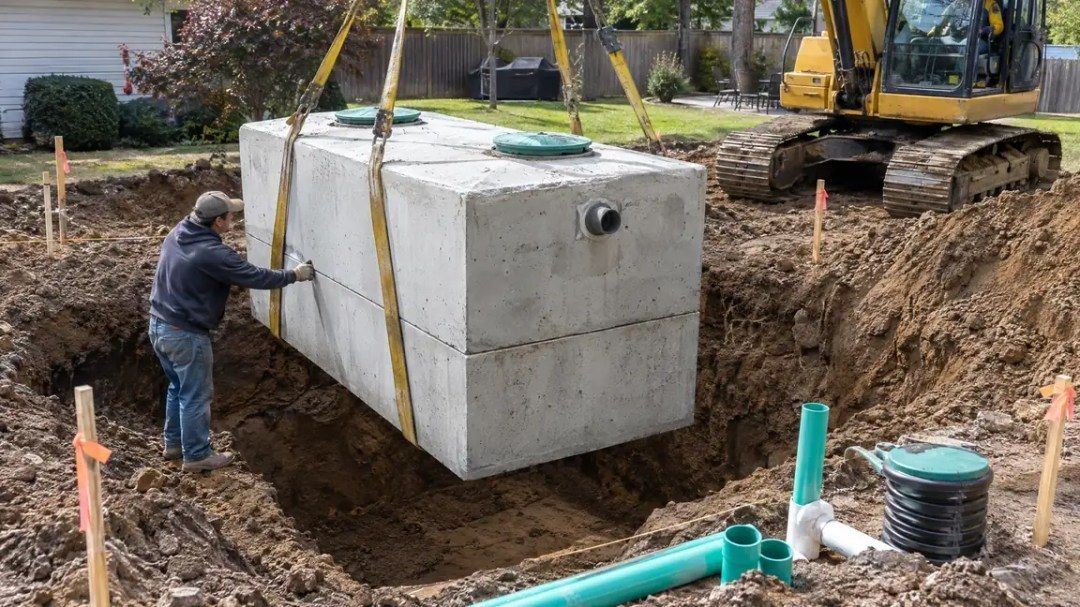
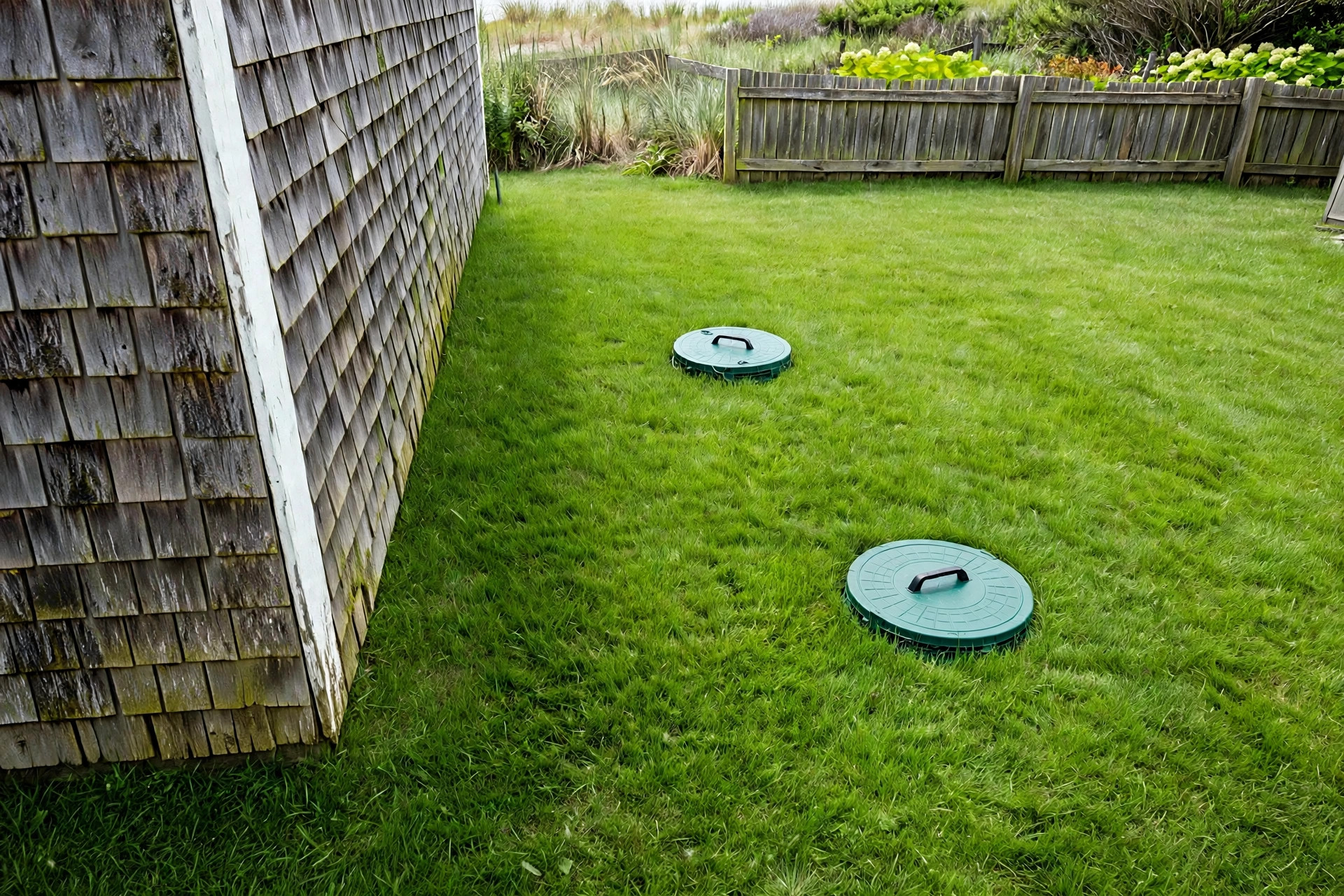
The design came first, because the Board of Health has to approve it before anything is dug. A three-bedroom house carries a design flow of 330 gallons per day. The new system was a conventional tank and leach field, a septic system replacement with a 1,500-gallon tank, baffles, an effluent filter, risers brought up to grade, a distribution box and a soil absorption area laid out within the setbacks. The old cesspool was pumped out and decommissioned as the permit directed, so it could not collapse under the lawn or be put back into use by mistake.
The result
With the new system approved and in service, the sellers had a compliant system to hand over, along with the plans and installation records. The buyer's side had something it could read. The closing went ahead. The next owner will find risers at grade, a tank that can be opened in minutes, and a pumping schedule that fits the house.

See the change
If your own house has a closing date on it, the next step is a phone call. Ring (774) 619-8331 between 9:00 AM and 5:30 PM, Monday to Friday, and give us the street and the date. We will tell you what has to happen before the closing and in what order.
What a buyer of a Dennis seasonal home should establish before the offer
Seasonal houses carry their history in the ground, and the seller may not know it. Before you commit, work through these.
- The report. Is there one, and what is its date? Is it inside the two years the regulation requires? Was it done by a MassDEP-approved System Inspector, and was it filed with the Board of Health?
- The result. A pass, a conditional pass or a failure each means something different. If it is a conditional pass, ask which component was named, and whether the repair has been done with the Board of Health's approval. A cracked tank, a broken pipe, an uneven distribution box or a pump chamber can be conditionally passed. A cesspool or a soil absorption system cannot.
- The system type. Tank and field, cesspool, or something else? Cesspools are not condemned by existing, but they are often found at the transfer inspection, and one that shows hydraulic failure must be upgraded.
- The bedroom count against the approved design. Flow may not be increased beyond the design until the system is upgraded. If your plan is a bedroom addition or a year-round conversion, find out now.
- The pumping record. The last pumping date and the tank's reported condition tell you whether the three-year validity of an inspection can still be claimed.
- The Board of Health file. Ask the Dennis Board of Health what applies to the parcel, including any Local Upgrade Approval, which is the board's approval of maximum feasible compliance where full compliance is not feasible.
- The budget. Allow for the system on its worst reading. A distribution box repair is $500 to $1,500. A conventional replacement is $18,000 to $32,000, or $25,000 to $40,000 on a tight lot. A nitrogen-reducing I/A system is $32,000 to $55,000, and the maintenance contract that goes with it runs $400 to $900 a year.

What the work costs here
Every price below is what we charge, and the same figure applies on every page.
| Service | Price |
|---|---|
| Title 5 inspection | $475 to $850 |
| Title 5 inspection booked together with pumping | $600 to $1,200 |
| Septic pumping, 1,500-gallon tank | $375 to $575 |
| Distribution box repair | $500 to $1,500 |
| Conventional septic system replacement | $18,000 to $32,000 (tight lots: $25,000 to $40,000) |
| Nitrogen-reducing I/A system | $32,000 to $55,000 (tight lots and high water table: $45,000 to $75,000 or more) |
| I/A maintenance contract | $400 to $900 a year |
Three programmes help with the larger jobs, and each has its own terms. The Cape Cod AquiFund is Barnstable County's betterment loan for repair, replacement, I/A installation or sewer connection. It is repaid on the tax bill over up to 20 years and paid directly to the contractor. The state septic tax credit covers 60 percent of the cost of repairing or replacing a failed system on a principal residence, with costs capped at $30,000, up to $4,000 a year and $18,000 in total. The MassHousing Septic Repair Loan is up to $25,000 for owner-occupants of one to four family homes, with income limits.
Questions
How long before a Dennis sale does the inspection have to be done?
Within the two years before the property transfers. If weather prevents it, it may be done within six months after the sale, with written notice to the buyer.
What does a Title 5 inspection cost?
$475 to $850. Booked together with pumping, the two come to $600 to $1,200.
Why is the tank pumped before the inspection?
Because an inspector cannot read the baffles, the outlet tee or the sludge and scum layer in a tank that is full. Pumping first gives the inspector a view of the tank's condition and a baseline for the report.
The house has been closed all winter. Does that affect the inspection?
It can affect timing. If weather prevents the inspection before the sale, the regulation allows it within six months after, with written notice to the buyer.
Who is allowed to do the inspection, and where does the report go?
Only a MassDEP-approved System Inspector. The report goes on the state form to the local Board of Health within 30 days, and the seller gives the buyer a copy.
What if the inspection finds a cesspool?
A cesspool is not condemned simply for existing. It must be upgraded if it shows hydraulic failure, sits very close to a water supply, or fails to protect health and the environment, and always before any increase in design flow. A cesspool cannot receive a conditional pass.
How long do we have to fix a failed system?
Two years, unless the Board of Health or MassDEP sets another schedule, and sooner for an imminent hazard. The duty sits with the owner even if the sale falls through.
Who pays for the upgrade, the seller or the buyer?
The contract between them decides. The regulation puts the duty on the owner, and the cost is negotiated, either by the seller upgrading before closing or by a price adjustment with the buyer taking it on.
What does a replacement cost?
A conventional septic system replacement is $18,000 to $32,000, or $25,000 to $40,000 on a tight lot. A nitrogen-reducing I/A system is $32,000 to $55,000, and $45,000 to $75,000 or more on a tight lot with a high water table. The I/A maintenance contract is $400 to $900 a year.
Is there help paying for it?
The AquiFund betterment loan, repaid on the tax bill over up to 20 years, carries a 5 percent rate where the property is listed or expected to be listed within 12 months. The state tax credit applies only to a principal residence, so a second home does not qualify. The MassHousing Septic Repair Loan, up to $25,000, is for owner-occupants and has income limits.
What does a conditional pass mean?
A named component, such as a cracked tank, a broken pipe, an uneven distribution box or a pump chamber, is repaired with Board of Health approval. A distribution box repair is $500 to $1,500.
Can one inspection cover a sale that falls through and a relisting?
Yes. One inspection covers more than one transfer inside the two-year window.
How often should a seasonal house be pumped?
MassDEP's guidance is at least every three years without a garbage disposal and every year with one. Pumping a 1,500-gallon tank is $375 to $575.
Does adding a bedroom change anything?
Yes. A change needing a building or occupancy permit triggers an inspection, and flow may not exceed the approved design, sized at 110 gallons per day per bedroom, until the system is upgraded.
Tell us about your Dennis house and we will tell you where it stands. The form below asks for your name and a phone number, and nothing else is required. Add the street, the closing date, what you know about the system, or the questions on your mind if you like. The more details you give, the better we are able to help you. You can also reach Barnstable Septic at (774) 619-8331, Monday to Friday, 9:00 AM to 5:30 PM.