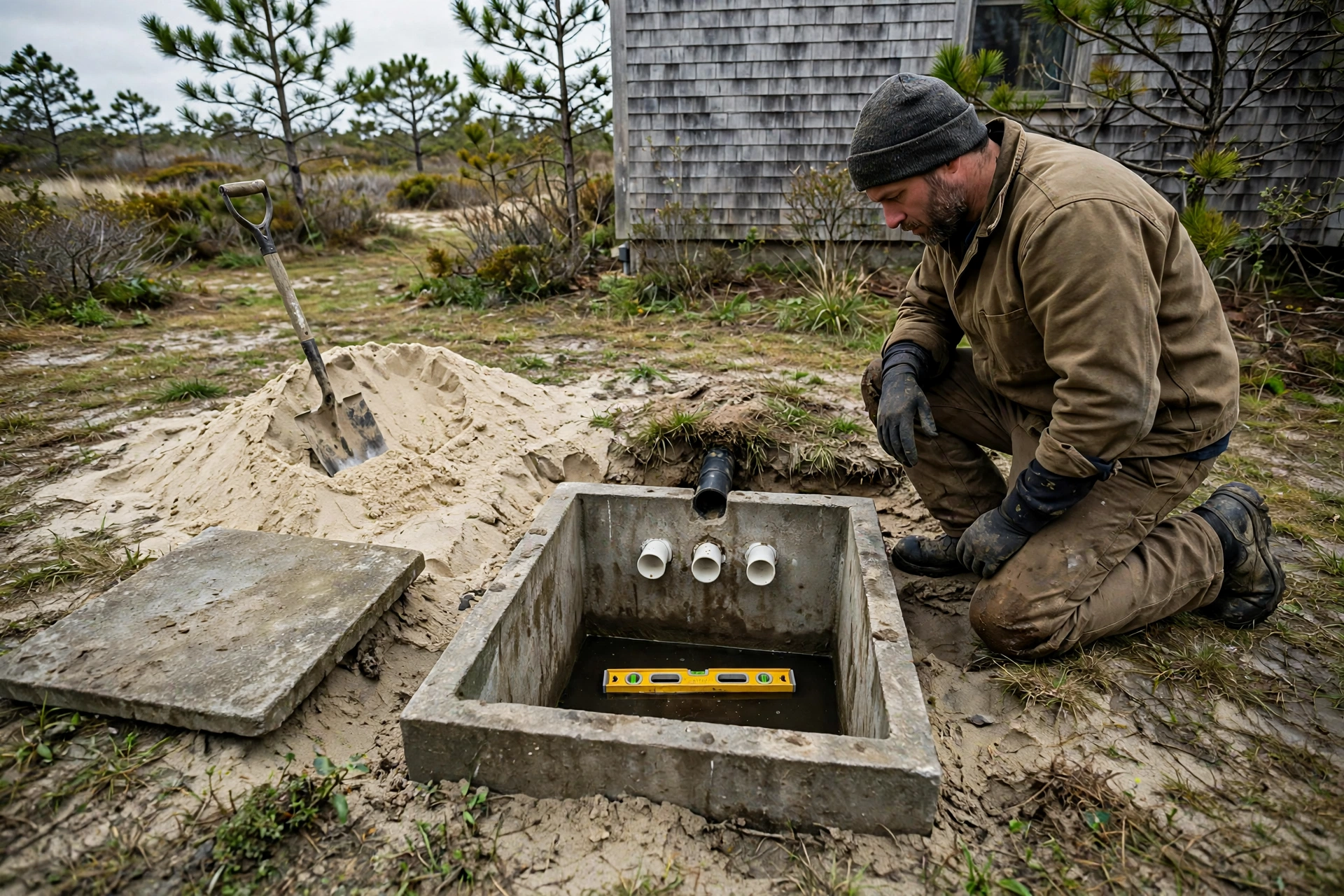
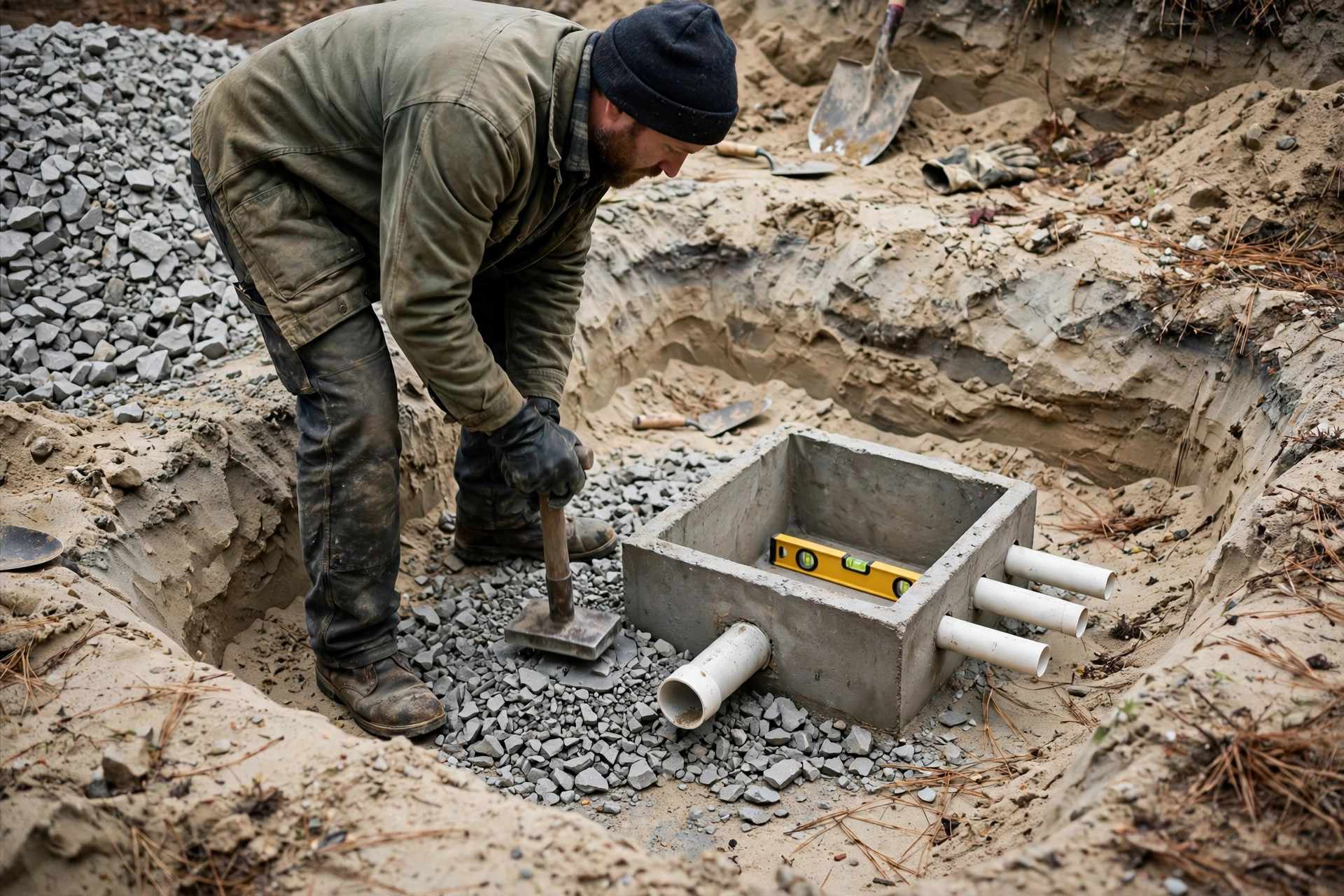
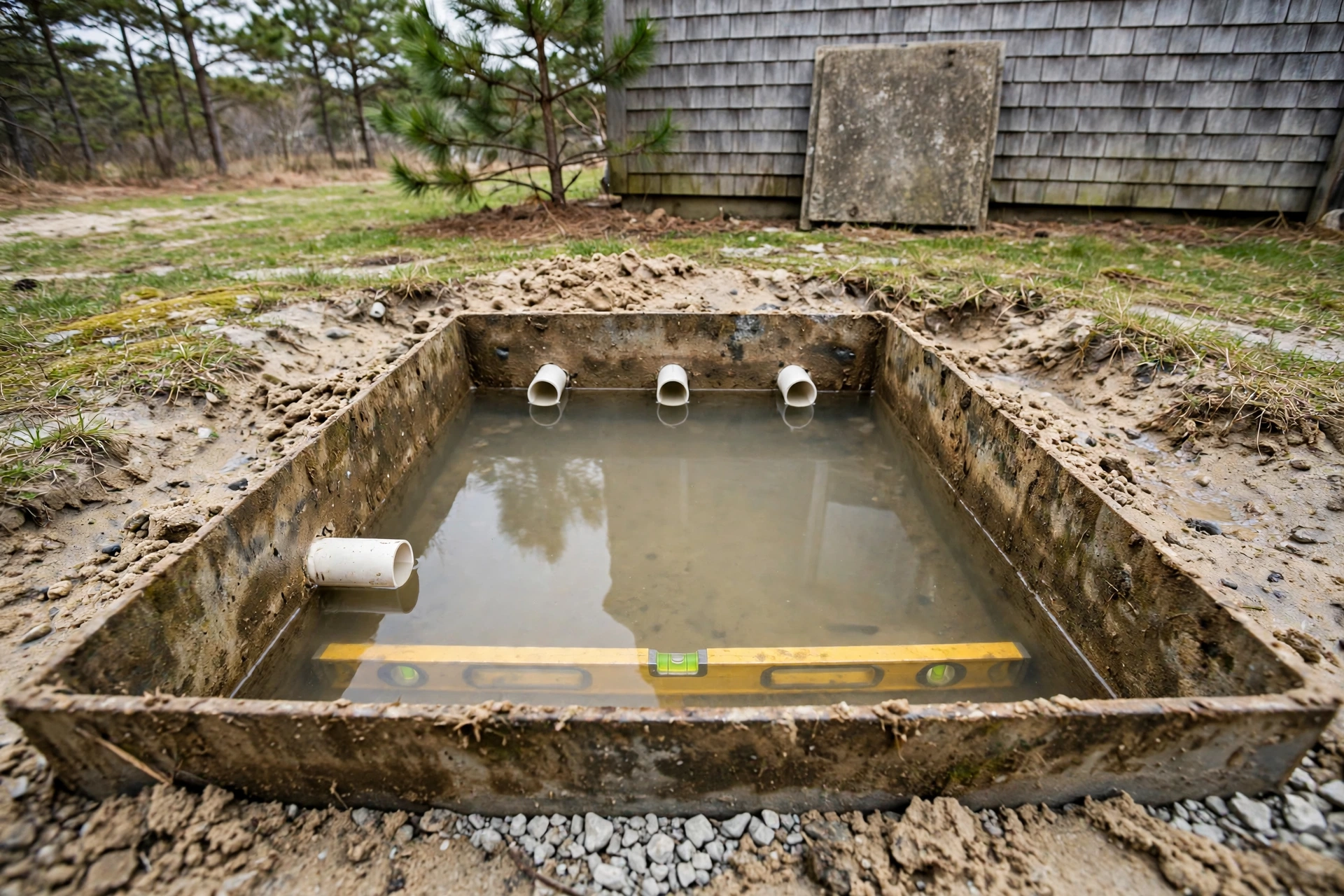
An opened distribution box. The box splits the tank's effluent among the lines of the leach field, and the level across its floor shows whether each outlet sits at the same height.
Septic repairs that fix the failed part and leave the sound ones alone
Most septic repairs are modest jobs: a box that has settled, a pipe that has broken, a baffle that has rotted away. Barnstable Septic is a Hyannis-based company working across Barnstable, Yarmouth and Dennis, and the first thing we settle on any call is which part has actually failed. A septic system repair aimed at the wrong component costs money and fixes nothing.
The part owners hear about most is the distribution box. A distribution box repair means leveling the box that divides flow among the lines of the leach field, or replacing it when it has cracked or shifted past saving. The tank has its own repairs. Septic tank repair covers cracks, failed baffles and tees, and broken risers and lids, and it sits alongside pump chamber repair for the homes that lift effluent to the field with a pump.
Between the tank and the field run the pipes, and a septic pipe repair means finding the break and replacing that run, not digging the whole yard. Every septic component repair on this page is also one that Title 5 can accept at a sale in place of a failed inspection, within limits that are worth knowing before you hire anyone. If you have an inspection report in hand or a symptom you cannot place, call (774) 619-8331 or use the form further down this page, and we will start from what you are seeing.
What Title 5 lets a repair do, and where it stops
When a system is inspected before a sale, it has one of three outcomes: pass, conditional pass, or fail. A conditional pass is the repair outcome. The inspector names a specific component, you repair it, and the Board of Health approves the repair.
These are the components that can be conditionally passed:
A cracked or metal tank
A broken pipe
An uneven distribution box
A pump chamber
Two things cannot be conditionally passed: a soil absorption system and a cesspool. If the leach field itself has failed, or the property has a cesspool that does not pass, no component repair rescues the inspection. That is a failed system, and under 310 CMR 15.303 a failed system means an upgrade within two years unless the Board of Health or MassDEP sets a different schedule, sooner if there is an imminent hazard. The duty to upgrade stays with the owner even if the sale falls through.
This boundary is the most useful thing to know before you spend anything. A repair works when the field and the soil beneath it are still doing their job and one part upstream is not. When the field is what has failed, repair money is better spent toward replacement. The septic installation and replacement page covers that work, and cesspools are handled on the cesspool replacement page.
Some conditions are failures on their face, not repair candidates: sewage backing up into the house, effluent ponding or breaking out at the surface, or liquid standing in the distribution box above the outlet. The inspector reads those findings, not the contractor.
Signs a component is failing
Septic parts rarely announce themselves, but they leave patterns:
Uneven draining across the field. Wet ground over one section and dry over the rest often points to a box that no longer splits flow evenly.
One line taking the load. When a single line works while the others sit idle, that line ages years faster than the rest.
Sewage odor at the tank. A missing baffle, a failed tee or a cracked or ill-fitting lid lets gas escape where it should not.
Slow drains after pumping. A freshly emptied tank that does not cure slow drains means the problem is downstream of it: a blocked or broken pipe, a box, or the field.
A wet patch over one part of the field. That can be a broken pipe, a failed line, or a field section that has had too much flow.
A pump chamber alarm or a pump that runs without stopping. The floats or the pump itself are the first suspects.
None of these names the component by itself. They tell the crew where to dig first.
How the crew finds out which part it is
The work starts with a look, not a shovel. We open the tank and read the baffles, tees and the effluent filter, and note the tank's material and condition. We find the distribution box, open it and read the levels. We camera or probe the pipe run between tank and box and between box and field when a break is suspected. At a pump chamber we check the floats and the pump and run the cycle.
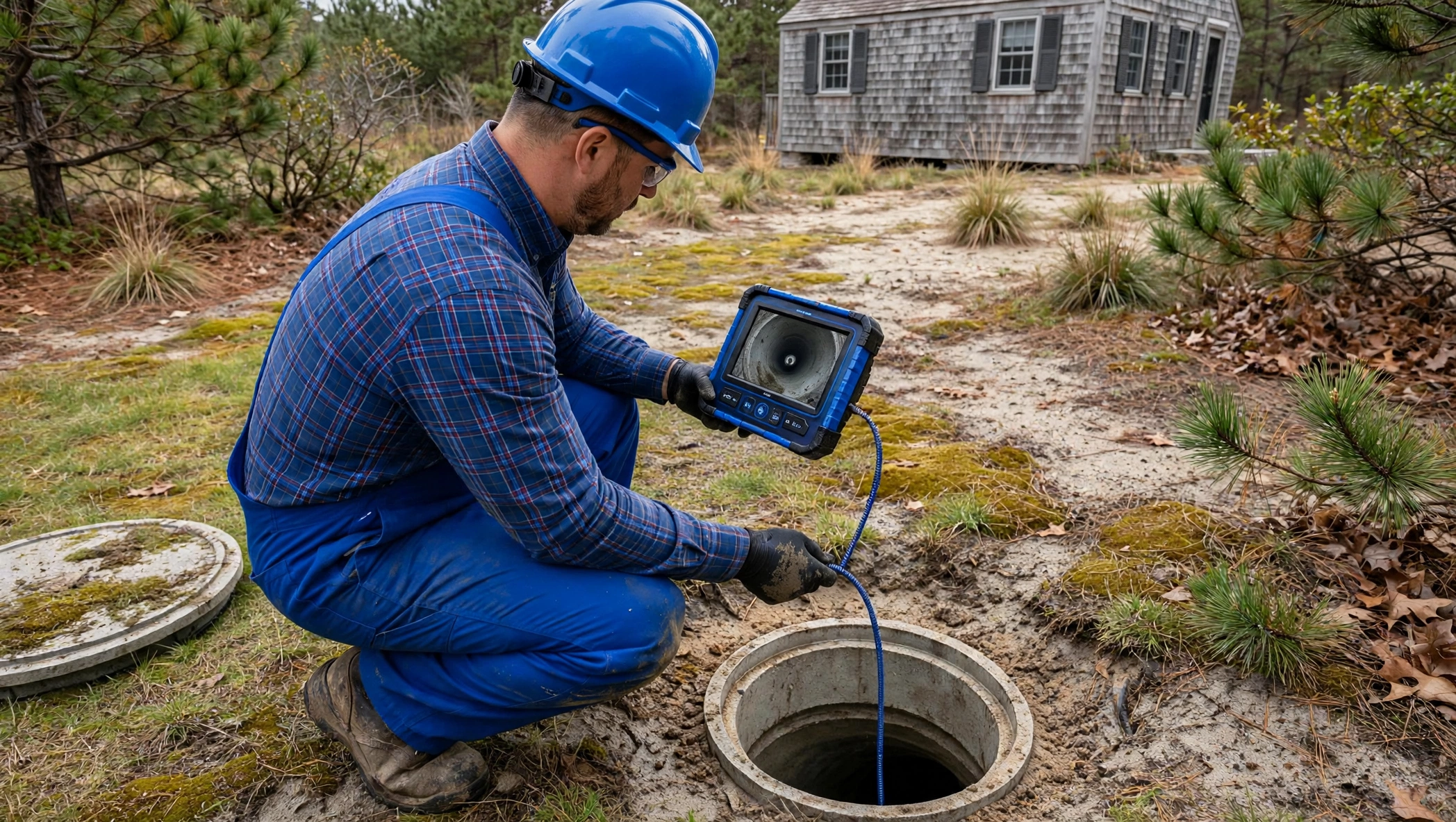
A camera run down the outlet pipe shows a break, a root intrusion or a sagging section of pipe, so the dig is limited to the one run that needs it.
Tell us what you are seeing, or send us the inspection report you were handed. We will talk through which component it points to and what the repair involves. Call (774) 619-8331, Monday to Friday, 9:00 AM to 5:30 PM, or use the form on this page. The form asks only for your name and a phone number. Everything else is optional, and the more details you give, the better we are able to help you.
How a repair goes, step by step
1. The call, and the symptoms taken
We ask what you have noticed and where, how many bedrooms the house has, whether a garbage disposal is in use, when the tank was last pumped, and whether a Title 5 inspection is behind the call. If there is a report, we read the inspector's wording closely because it decides what the Board of Health will accept.
The inspection form's own wording, such as "distribution box not level," tells us whether we are looking at a conditional pass component or something the Board of Health will treat as a failure.
2. The system opened and the failed part found
We locate the tank and box, uncover them and read what is there. Often the tank is pumped first so the baffles, tees and walls can be seen clearly.
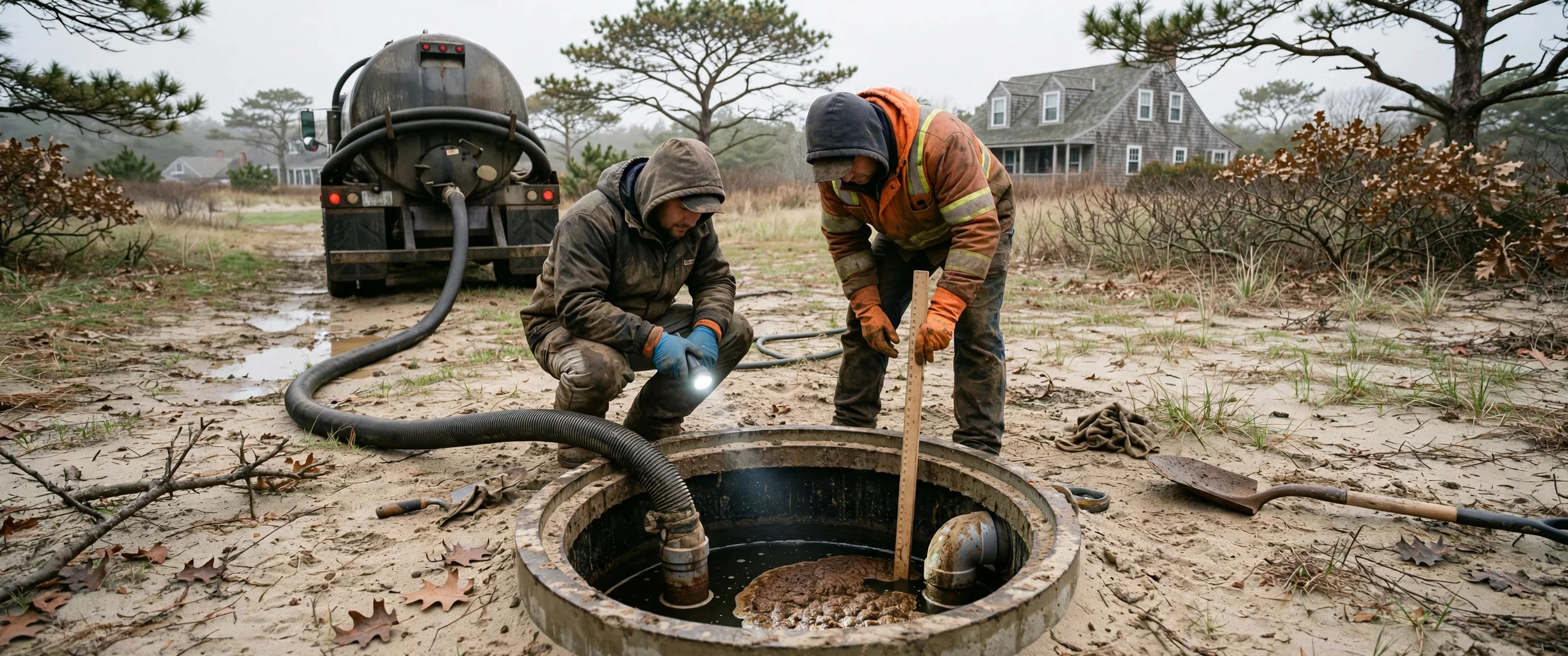
With the tank pumped down, the baffles, the outlet tee and the walls are visible. A tee missing or a baffle fallen away is a common reason for odor and a clogged effluent filter.
3. The repair scoped, and the Board of Health path where Title 5 applies
We tell you what failed, what the repair is, and whether it is a repair or a replacement matter. Where the repair answers a conditional pass, the Board of Health must approve it, and the inspection report goes to the Board on the state form within 30 days of the inspection. Where no sale is involved, the scope is simply what the system needs.
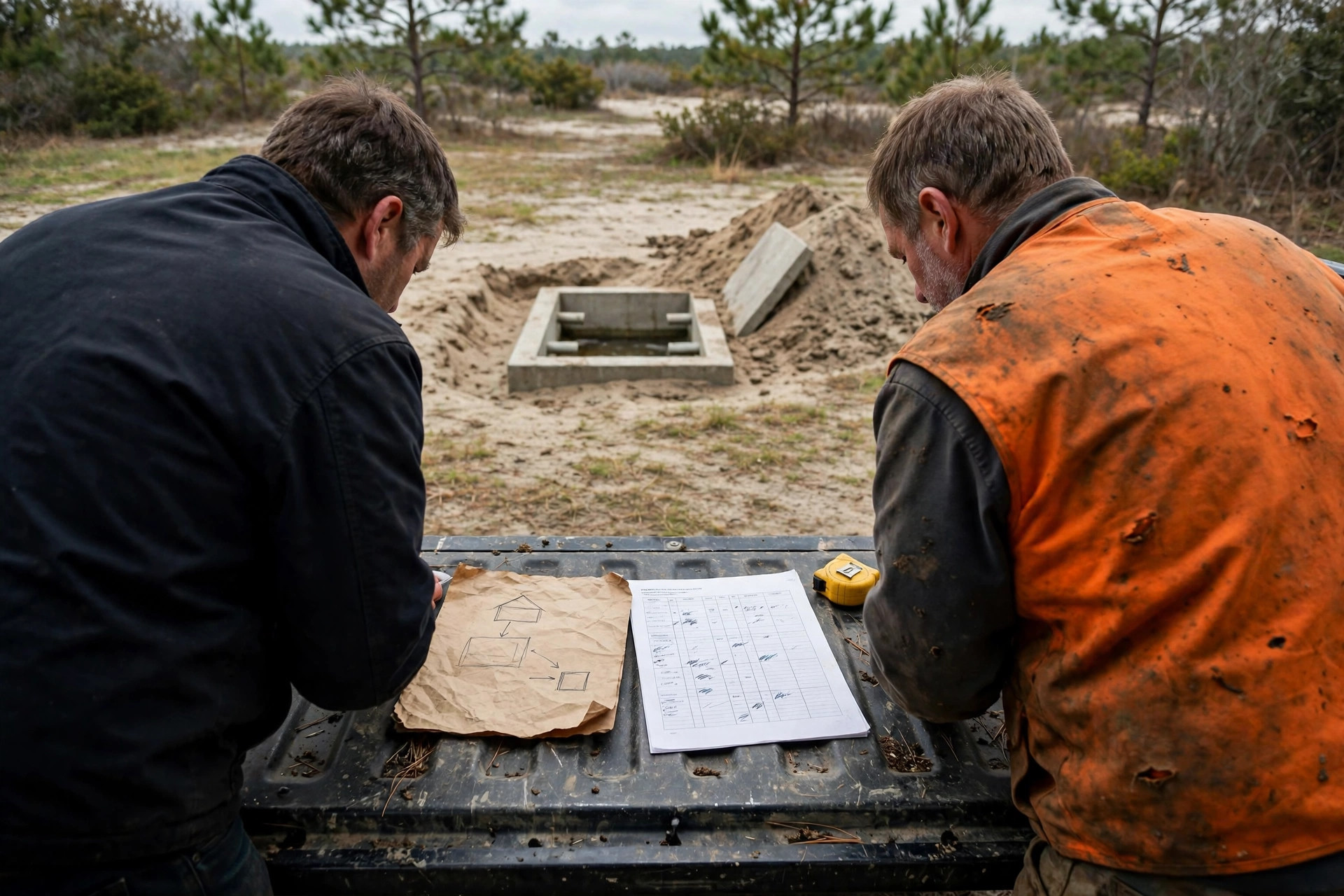
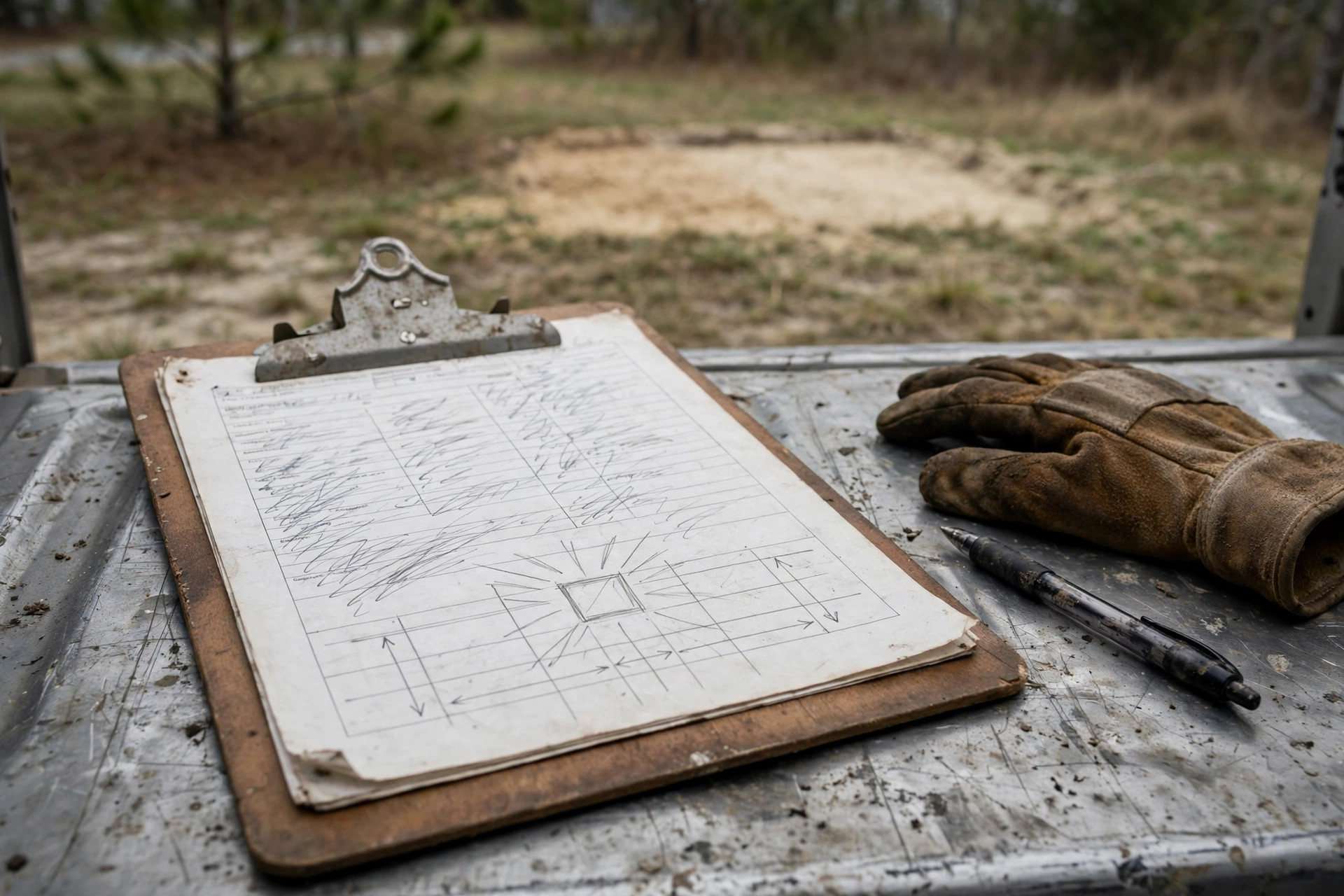
Scoping happens at the opened box, with the homeowner there. The sketch marks tank, box, lines and the distances between them, which is what the Board of Health file needs.
4. The repair itself
The repair is the specific part. It might be a box reset on a compacted bed, a replaced tee, a new riser and lid, a pump swapped, or a pipe run cut out and replaced with new pipe laid to proper pitch.
A box that settles again was usually set on soft ground. Compacted stone beneath it holds the outlets at the same height year after year.
5. Levels and flow checked even
Before anything is covered, we check that the outlets sit level and that flow reaches every line. Where a pump is involved, we run it through its cycle.
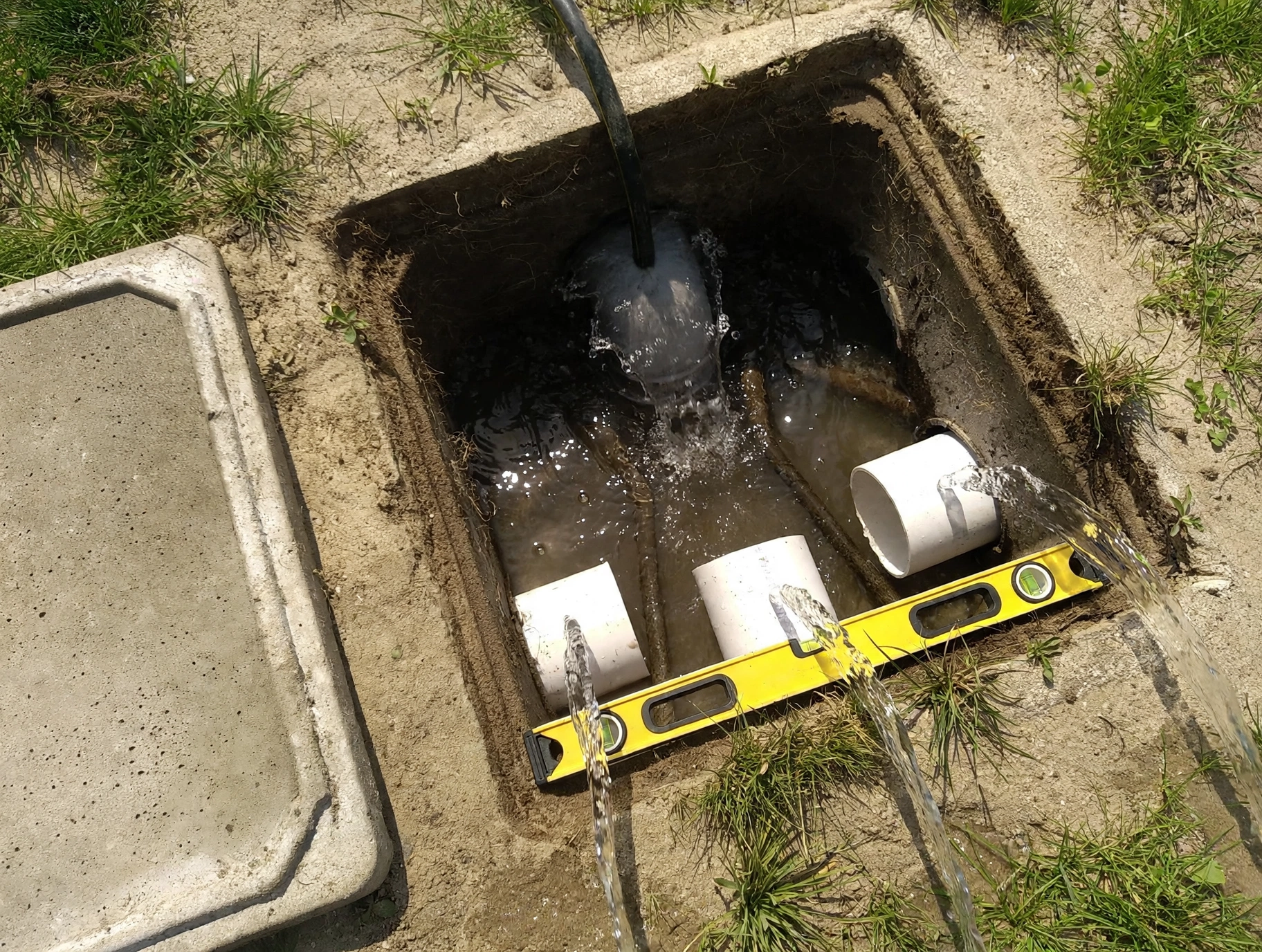
Clean water run through the box shows each outlet taking its share at the same moment. One outlet running ahead means the box is still not level.
6. The record left with the owner
You are left with a written description of what failed, what was done, and what to watch. For a conditional pass, the approval path and the paperwork that goes to the Board of Health are made clear, so the sale does not stall on a missing page.
A record with the box's location and the lines it feeds saves the next owner a probing session. Risers brought to grade make the box and tank easy to find without digging.
What each repair involves, and what drives it
Distribution box repair.
The box is opened and the outlets are read against each other. If the box is sound but has settled, it is leveled and reset on compacted stone. If it is cracked, or its outlets are damaged, it is replaced. A distribution box repair is $500 to $1,500. Where in that range depends on the depth of the box, how easy it is to reach, whether the box is leveled or replaced, and how much pipe around it needs correcting.
Cracked tank repair.
What matters is the crack and the tank. A crack above the liquid line in a sound tank is a repair matter. A tank that is cracked and unsound, or a metal tank, calls for a new tank, and Title 5 treats both as conditional-pass components when the tank is replaced under Board of Health approval. Tank material, condition, size against the home's design flow, and access for the excavator are what shape the job.
Broken pipe repair.
A camera or probe finds the break, and that run is replaced with new pipe laid to pitch. The length of the run, its depth, what lies above it, and whether it runs under a drive or a root zone decide the work.
Pump chamber repair.
The floats, the pump, the check valve and the alarm are tested, and the failed part is replaced. If the chamber itself is cracked or unsound, the chamber is the repair.
Baffle and tee repair or replacement.
A baffle or outlet tee keeps solids in the tank and out of the field. When one has rotted away or fallen, solids carry on to the pipes and the box. It is replaced, and the effluent filter is checked and cleaned while the tank is open.
Riser and lid repair.
Risers bring tank access to grade so a pumper or inspector does not have to dig. A cracked riser or a lid that no longer seats properly is a safety matter and a source of odor. Repair or replacement is the same visit.
Because only the box repair has a published price on this site, the others are described by what drives them, not by a figure. Repairs also often follow an inspection or pumping visit. A Title 5 inspection is $475 to $850, and $600 to $1,200 when booked together with pumping.
Before and after
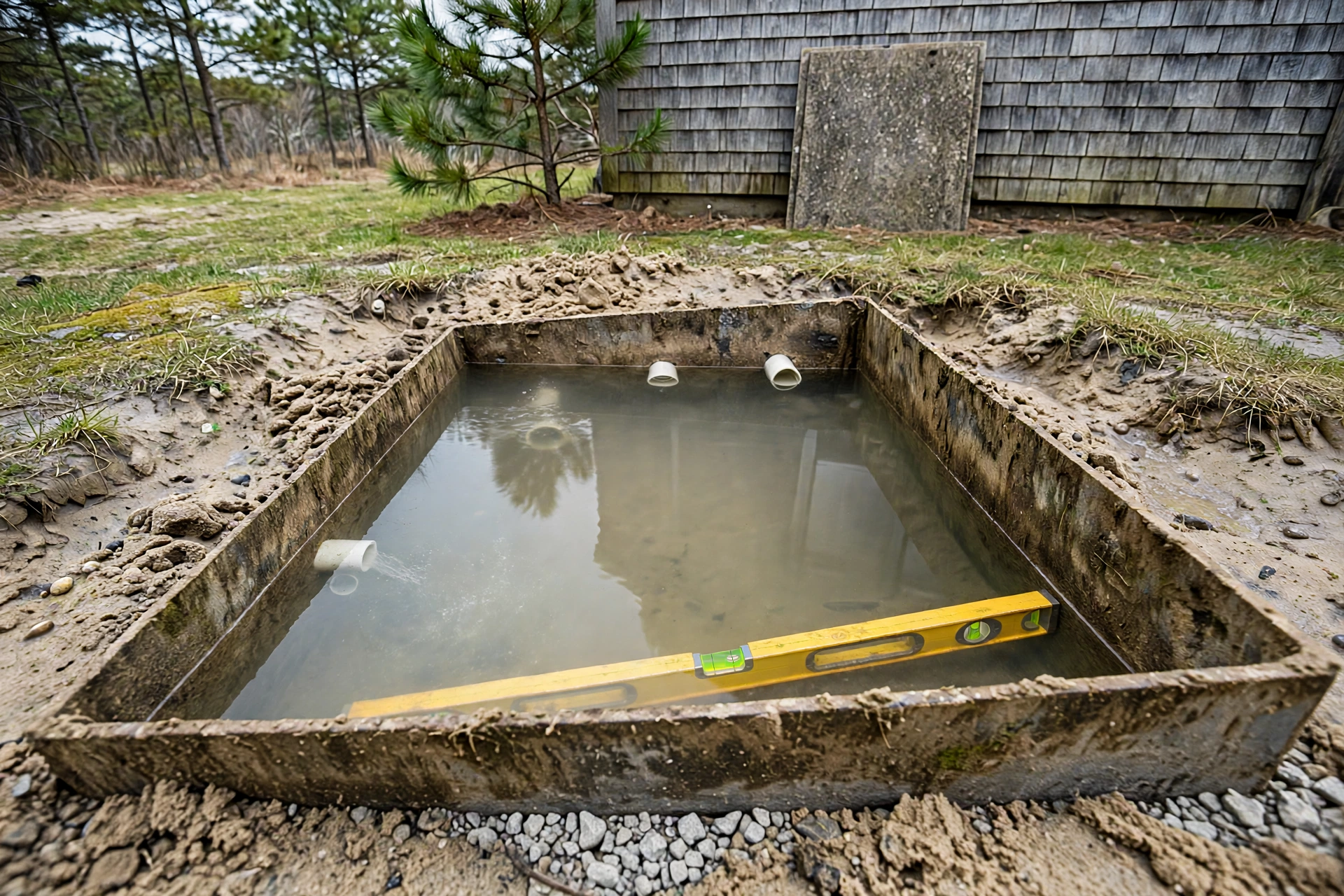
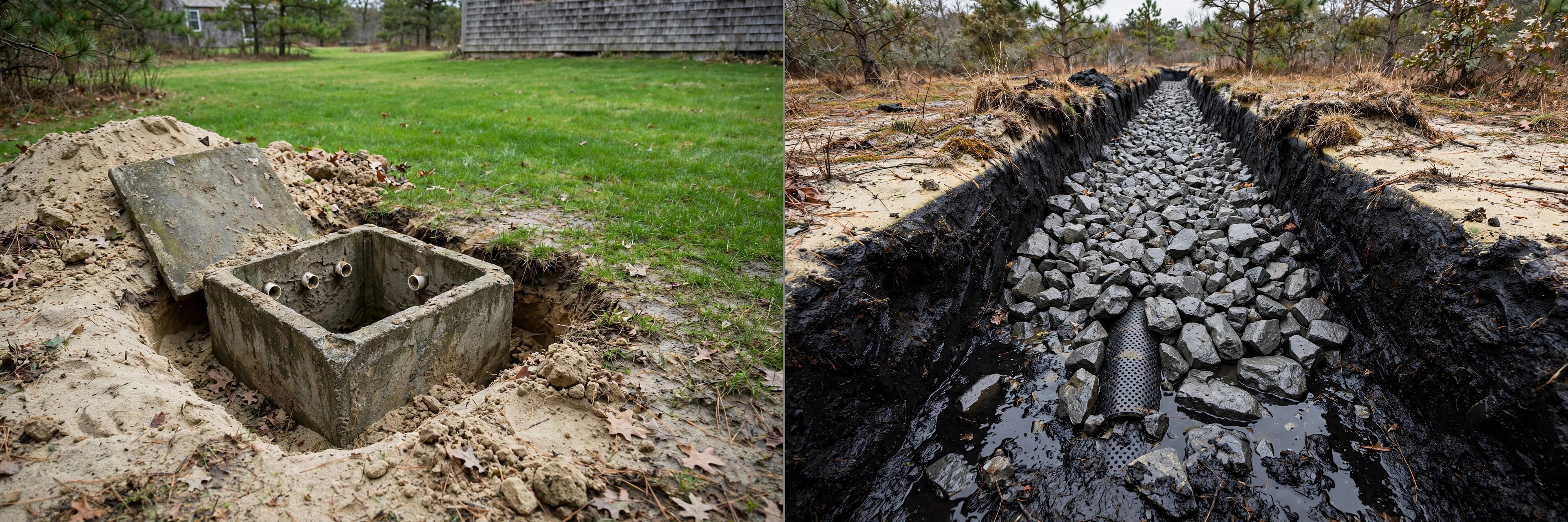
Before. One outlet is carrying nearly all the flow because the box has settled toward it. The line behind it is overworked while the others do nothing.After. The box sits level on compacted stone and each outlet takes the same share, so all the lines of the field work again.
Repair, or replace?
A repair buys real years when the tank and the field are sound and one part has failed. A box that settled, a pipe that broke, a tee that rotted, a pump that gave out: all of these repair well, and the system around them carries on.
A repair only delays the inevitable when the failed part is a symptom of something larger. A box that is uneven because the field behind it has failed is one example. A pipe that keeps clogging because the soil absorption system cannot take the flow is another. A soil absorption system that has failed, and a cesspool that fails, cannot be conditionally passed, and a repair around them is money spent on a system that will fail the next inspection.
When we open a system and find the field is the problem, we tell you so. The price for conventional septic system replacement is $18,000 to $32,000, or $25,000 to $40,000 on tight lots, and the work is laid out on the installation and replacement page. Where nitrogen rules apply, the I/A systems page covers that route.
Sound field soil is tan and drains; failed soil is black and stays saturated. What the crew sees in the soil often decides whether a repair is worth doing.
Featured job: a box leveled under a conditional pass on Shore Road, Dennis Port
A Dennis Port homeowner on Shore Road was selling, and the Title 5 inspection came back with a conditional pass. The distribution box was uneven and one line was taking nearly all the flow. The closing date was set, and the owner needed to know whether this meant a new system or something smaller.
We opened the box and read the levels. The tank was sound and the field had been drawing down well. Only the box had settled, which left one line working while the others sat idle. That is the kind of finding a repair answers, because the soil absorption system had not failed.
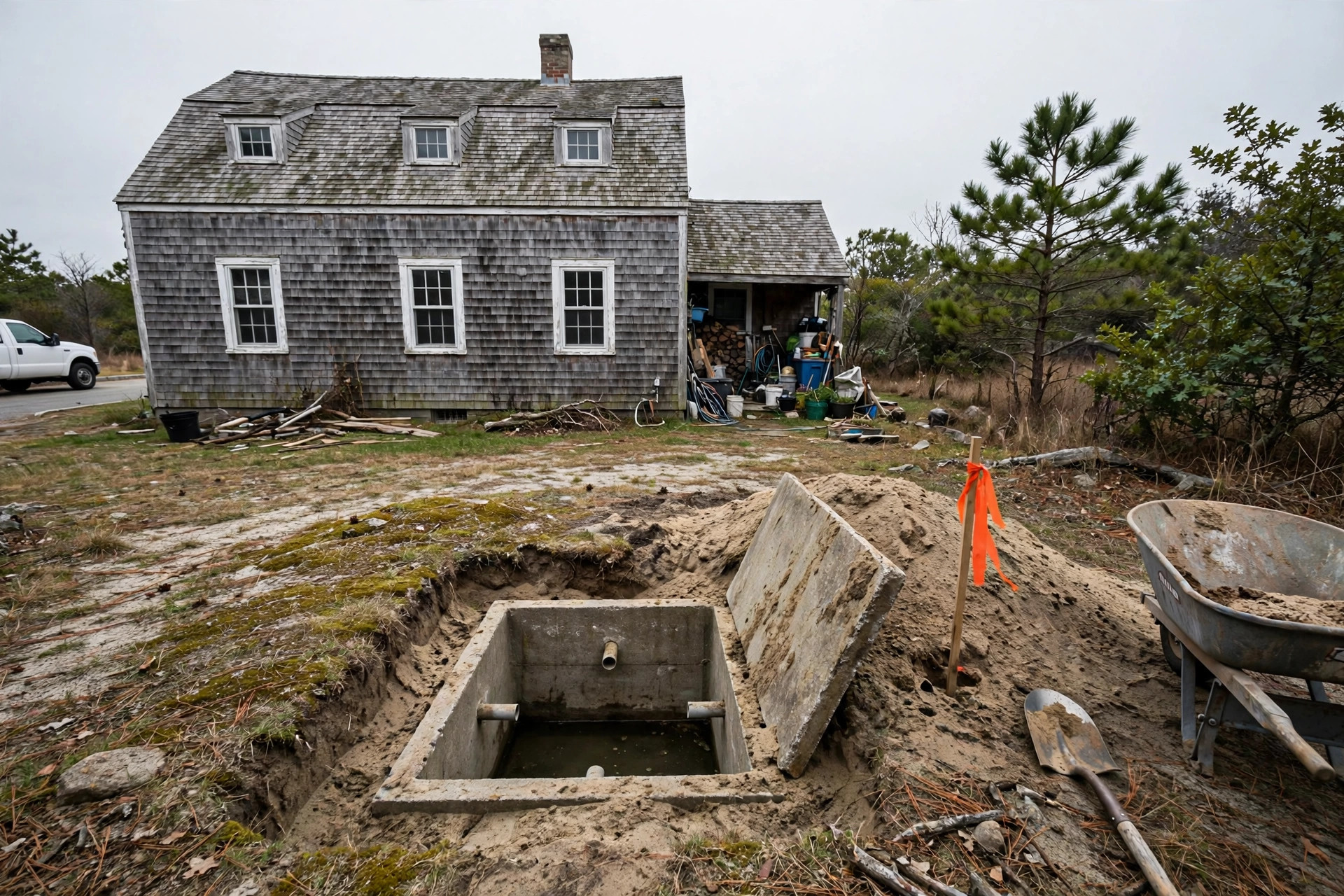
The box was exposed, its base was rebuilt on compacted stone, and it was reset level with each outlet at the same height. We ran water through to confirm each line took its share before covering it. With the Board of Health's approval of the repair, the conditional pass was resolved and the sale closed. The owner paid within the distribution box repair range of $500 to $1,500.
The box sits between the tank and the field. Flagging marks the field's edge so the excavation stays inside the area that needs work and does not disturb the lines that are working.
Help paying for septic work
Three programmes exist for owners, each with its own terms.
Cape Cod AquiFund is Barnstable County's betterment loan programme. It covers repair, replacement, I/A installation and sewer connection, repaid on the property tax bill over up to 20 years, and paid directly to the contractor. Septic work carries the 4% and 5% rates, 5% where the property is or is expected to be listed for sale within 12 months.
The state septic tax credit applies to a principal residence. It returns 60% of the cost of repairing or replacing a failed cesspool or septic system, with costs capped at $30,000, up to $4,000 per year and $18,000 in total, from tax year 2023.
MassHousing's Septic Repair Loan offers up to $25,000 to owner-occupants of one to four family homes, with income limits.
Questions
Questions
Can a cracked tank be repaired, or does it have to be replaced?
It depends on the crack and on the tank. A crack in a sound concrete tank can be repaired. A tank that is cracked and unsound, or a metal tank, needs to be replaced. Title 5 lists a cracked or metal tank as a component that can be conditionally passed when the repair is made with Board of Health approval. We open and read the tank to say which one you have.
Does a repair need Board of Health approval?
When the repair answers a Title 5 conditional pass, yes. The Board of Health must approve the repair of the named component. A repair made outside any inspection, simply because something has failed, is scoped to what the system needs, and we walk you through whether the Board of Health needs to be involved.
How long does a distribution box repair take?
In process terms, most of the work is finding and uncovering the box and backfilling it afterward. The leveling itself is short. The steps are: open the box, read the outlet levels, rebuild the base on compacted stone, reset the box, run water to check the flow, and cover it. A deep box, a hard-to-reach one, or a box that has to be replaced adds digging, not steps.
Will a repair pass a Title 5 inspection?
A repair of a conditional-pass component, made with Board of Health approval, resolves the conditional pass. It does not rescue a system whose soil absorption system or cesspool has failed. Those cannot be conditionally passed, and the system fails.
What can and cannot be conditionally passed?
A cracked or metal tank, a broken pipe, an uneven distribution box and a pump chamber can be repaired under a conditional pass. A soil absorption system and a cesspool cannot be conditionally passed. If either has failed, the system fails and must be upgraded, normally within two years.
What does a distribution box repair cost?
A distribution box repair is $500 to $1,500. Depth, access, and whether the box is leveled or replaced decide where in that range the job lands. For the other repairs, we describe what drives the work, such as tank material, pipe run length and depth, and access, because the price depends on what the opened system shows.
How do I know which component has failed?
Symptoms point toward a part but do not name it. Uneven wet patches suggest the box, odor at the tank suggests a baffle or lid, and a pump that runs constantly points to the floats or pump. The crew confirms by opening the tank and box, running a camera or probe along the pipes, and testing the pump chamber.
Can a cesspool be repaired?
A failed cesspool cannot be conditionally passed, so a repair does not carry a sale through. A cesspool is not condemned for existing, but it must be upgraded when it shows hydraulic failure, sits extremely close to a water supply, or otherwise fails to protect health, and before any increase in design flow. The cesspool replacement page covers that work.
Should the tank be pumped before a repair?
Usually yes. An empty tank lets the crew see the walls, baffles, tees and filter. Pumping and a Title 5 inspection booked together cost $600 to $1,200, and a pumping alone for a 1,500-gallon tank is $375 to $575.
Can I add a bedroom after a repair?
An added bedroom needs a building or occupancy permit, which is itself a trigger for a Title 5 inspection. Title 5 sizes a home at 110 gallons per day per bedroom, 330 minimum, and flow may not be increased beyond the approved design until the system is upgraded. A repair does not change the design flow.
My street is getting a sewer. Should I still repair my system?
Check the Town of Barnstable's sewer plan for your parcel first. Under the Board of Health's rules, a building abutting a way with a public sewer must connect within 6 months of the Board's letter, and a hydraulically failed system within 60 days. If a connection is coming, a large repair may not make sense. Ask us what the system needs to function until then.
How do I pay for a repair?
AquiFund betterment loans, the state septic tax credit and the MassHousing Septic Repair Loan all apply to septic repair, each with its own terms, which are set out on this page.
If an inspector has named a component, or your system is giving signs you cannot place, call Barnstable Septic at (774) 619-8331, Monday to Friday, 9:00 AM to 5:30 PM, or send your name and phone number through the form above. We will talk through what you are seeing and what the repair involves, in Barnstable, Yarmouth or Dennis.